Monthly Archives: July 2009
More nostalgia
Becca turned me on to this site, which I thought was kinda cool, Place and Memory. It is a wiki of places that no longer exist. How awesome is that, and useful too. Well, for those of us who are fixated on recapturing our once glorious past, it is perfectly cathartic. And recorded versions of stories make it onto NPR. In any case, the very first place I thought of when I saw the site was Yosemite Nursery in Fresno, and I wrote the Entry below. Though I would encourage you to read it at the site and make your own entry about a place that no longer exists.
My family moved to the neighborhood when I was about 5 years old. We lived on Griffith Way. At the top of the street was Hwy 41/Blackstone Ave, and there on the corner was this amazing place. It was an amazing nursery with a large variety of plants, trees, soil, mulches and so on. It was owned by a Japanese family and their house was on the Griffith side of the property, with the nursery sprawling behind it. In front of the house was a koi pond, or series of ponds, with connecting streams and Japanese bridges, meticulously pruned black pines and other topiary.
The parking lot was on the Blackstone side. At the back of it stood the business office and covered areas for shade plants, bonsai, and also the fish hatchery! There was a series of troughs with koi, goldfish, etc. I seem to remember that they were segregated by size to some extent. Around the outside of the parking lot, along the street were huge piles of feather rock for sale. Feather rock is volcanic rock that has a sponge-like structure, which makes it very light for its size. It is also essentially glass, which means it is very easy to get cut up when you climb on it, as we often did. I remember that that it came in two different colors, a glossy black, and a more muted gray.
Down the block from the house on the Griffith side was a series of large stalls containing different soils and mulches, and so on. There was tractor that was used for loading material into customers’s trucks. I still remember clearly the sweet, bourbon-y smell of the redwood forest humus.
Behind all this lay the vast (to a kid) interior of rows and rows of trees and plants, hiding places, and mysterious objects. I loved going there with my parents and running off to throw pennies, or just pebbles, into the koi pond, to look at all the curious, colorful figurines and statues for sale, to get lost in the backwoods, and to feel the cool, damp soil between my toes on a scorching Fresno summer day.
Fresno continued to grow northward, and what was once a north gate on Hwy 41 heading to Yosemite, became a rural holdout in the middle of the city. Eventually, I don’t remember exactly when, the place closed and the property was developed into an L-shaped strip mall.
By: Neocles
Blog to Remember: A Recipe for Pasta
As a new means of annoying readers–ahem, remembering things I’ve cooked so I can do it again–I will start posting kitchen exploits. This one, involves last night’s dinner. As usual, dinner last evening was a last minute affair. Searching through the fridge I found a couple packages of grocery store ravioli, like maybe Buitoni, with cheese and chicken. There was not much with which to make a sauce, particularly one that Theo would eat, but I dug around the pantry and fridge to see what I could find. While hunting around the freezer, I saw some frozen peas. That caused me to flash on a dish I remember eating at an Italian place in Fresno about 2o years ago. Unfortunately, I can’t quite remember the name of the place. It was out on Shaw Ave near West. It was owned by one of the kids or something of the Fresno Italian Restaurant dynasty, the DiCicco’s. Wait! Lido’s is what it was called, I think. The place was pretty cuisine-y for Fresno in those days, different feel than the old school chain places the family ran, and apparently still runs. It was a pasta course with a creamy tomato sauce with peas. It was good, and the memory wouldn’t let me go. I thought, “What the hell, I’ll play with that idea and see what happens.”
I found a small onion, chopped it fine and threw it in a hot saute pan with a couple Tbls. olive oil. After the onions started to wilt, I turned the heat down and added a couple cloves minced garlic. I started adding some chicken broth, about 2/3 of a cup, but in about 3 or 4 increments, waiting for each to reduce down before adding the next. I learned this from Lynne Rossetto Kasper’s first book, “The Splendid Table”. I used to love to listen to her show on KUOW in Seattle, and still can’t really believe there is not a single freaking station in the SF Bay Area, self-annointed foodie capital of America, that carries the program. At least there’s a Website and podcasts.
I finely diced a couple smallish carrots, and threw those in with the last of the broth. While that was simmering, I measured up a cup of the frozen peas, and found a large can (24 oz?) of chopped tomatoes in the pantry. Chopped would not do, so I got out my aged Cuisinart food processor and zinged them up really well. I still have the first Cuisinart I ever bought, a DLC-10 plus, which was in about 1985 or so. The model was later renamed The Classic, or something like that. I can’t believe it still runs. Maybe it will outlast me. I wonder if the new ones are still built like this. I’d be happy to endorse their products. At least their food processors. At least the ones they sold in the mid-80’s.
Anyway, I threw the pureed tomatoes in to the pan and let that all simmer for awhile. I’m not sure how long. Perhaps long enough to boil 4 quarts of water for the pasta. Then I added the peas and salt and pepper. After a few minutes of cleaning up, I put the pasta on. Then I had to face facts. I had no cream. And I have NEVER had luck adding milk, or even half-and-half to a sauce. It always curdles. And I was not going to the store now. I stood there staring into the refrigerator and finally saw the Greek yogurt–you know that brand no one can really pronounce, FAH-yeh. Damn that shit is good. Anyway, I got brave and finished the sauce with a couple-three big spoons of that full-fat Fage. I added until it looked the right color.
There was almost enough vegetable matter in it to justify going with it as a one dish meal. So we did. And you know, it wasn’t half bad. Sorry I didn’t get picture. You’ll just have to make it yourself to see it.
Fingado Art Gallery Opening
This is the final set of images I will have in a group photography show that opens Friday at Fingado Art Gallery. Nine is quite a few but the prints are not very big, just 12 inches square. I printed them at Dickerman Prints and had them mounted on aluminum at General Graphics, both in San Francisco. They came out very nice, and I’m pretty excited about it.
It has been an interesting project to try to print and prepare for presentation a small set of photographs. In a way, it seems easier than simply showing things on the web. I think the reason for this is that a physical show has, by its very nature, physical limitations and boundaries. A small set of images allows one to focus on them and the process of getting them where you want them to be. By contrast, putting things up on flickr or another such site is pretty much wide open in terms of numbers and organization. One can drown in a sea of possibilities.
This was my thought about what’s going on with this series of photos. The starting point is an exploration of color. Not color simpliciter, but as it relates to memory, history and the fictional narratives they constitute. The combination of color shifts and vintage subjects recall a generic past and, paradoxically, place the viewer within a fictitious historical narrative by playing upon her memories and nostalgic sensibilities. The deportation is paradoxical since taken literally, these narratives describe a logical impossibility. The images waver between recalling a past as it was, and a decayed, dissolving past as it comes to us. On one hand we are presented with something recalling a snapshot from the family drawer, a snapshot whose color as shifted over time, but whose referent we can conjure through memory as pristine. On the other hand, the subject is captured and presented not as it was in the past, but as it is now, in the present. It is the color, as it were, of the subject itself which has shifted over time rather than the photograph.
Community=trust, or is it the other way around?
So, I roll into my new favorite wi-fi enabled coffee office, and as I am about to order I see that they don’t take credit cards yet, and I know I have no cash, and the nearest cash machine will charge me more than the cost of a cup a joe to give me my own money. And the nearest Wamu-Chase joint is a 15-minute bike ride away.
So, as I am thinking about all this, the woman at the counter, who turns out to be one of the owners, sees the look on my face and says, “no cash, eh?” And then she asks me if I wanna do an IOU? She says, “you look familiar”.
So, I am kind of blown away, because you definitely don’t get this anymore. I’ll be honest, i really liked this place anyway. It doesn’t hurt that the coffee is really good, as are the oatmeal-chocolate chip cookies and shortbread squares, the vibe is cool, the wi-fi is provided without an attitude, minimum purchase requirement, or sideways glance like you’re stealing something.
But now, they have a totally loyal customer for life. This is a down economy, and the restaurant business is tough in the best of times. This place is still new and could probably stand to see more cash flow. So, it is really gratifying to see people expressing trust and building community. One might argue that this is just smart business, and I would not disagree. I just think it is not all that common these days. So, you know, come get some coffee and a pastry. Bring cash.
Apricot Jam 2009

Apricots and some Strawberries by neocles, on Flickr
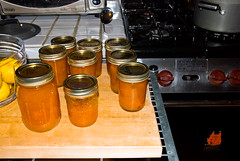
All Jammed Up by neocles, on Flickr
The apricot canning project this year was small but reasonably successful. I lost very few apricots due to my branch supports, and we ate lots of fresh ones. Finally the day came when they had to be picked, and I brought them all in. I kept them in the fridge to try to have fresh fruit on hand for as long as possible. But last night the time came to preserve the rest.
I couldn’t find the online recipe I used last year that included orange zest. But I had lots of lemons and so just went with the easiest thing I could find that called for some lemon juice. It also called for about 3/4 cup sugar to each cup fruit. I ran out of regular sugar a cup shy and so substituted brown sugar for the last cup. I like the slightly darker flavor it adds, but in retrospect, I probably should have just cut the sugar by a cup anyway. This batch is a bit sweeter than I remember the batch from last year being.
But it’s fun just the same and I’ve got jam to get me through the fall anyway. I guess canning is catching on. I heard this NPR story the other day on how canning classes are in demand as people try to revive this ancient alchemical skill in order to beat the bad economy. I can’t help thinking that there are all these things we as a society are doing totally wrong because we have been bamboozled into thinking that we can’t do anything ourselves, and that real happiness comes from buying everything and making nothing. We only get a glimpse of the truth when pushed by a crisis to rethink what we’re doing. Well, more on this in a future rant. Right now, I’m going to eat some some toast and jam.