Monthly Archives: March 2010
East Harlem Period
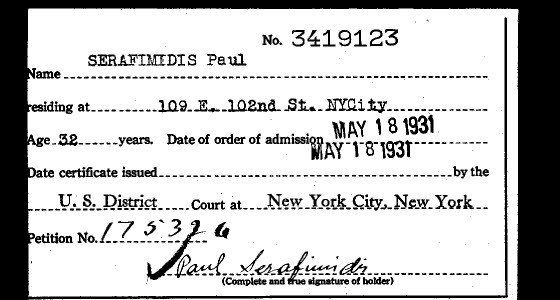
NY Petition for Paul Serafimidis, 1931
Two or three years ago I had a little jag of doing family research on the Web. It can be frustrating because very often, in between you and the information you want there is a lot of noise. And the noise isn’t random; it is designed to get you to pay for what you can usually get for free, or even just to search. My longing for lost youth and family identity has not yet reached the point where I will fork over money. For the time being, I satisfy myself with what can be found with free online searching. One day, I managed to get this little scrap of a scan with my father’s name on it. I have been meaning to do some more digging but never quite get around to it. Yesterday I came across it on my cluttered desktop, and I wondered if this address is still legit. So, naturally I mapped it on Googgle to check out the street view.
When I saw this, I immediately wondered what it might have looked like when my father lived there in 1931. I did some more searching to learn a little about the history of East Harlem. I noticed that right around the corner on 103rd St is St George-St Demetrios Greek Church. From what I can tell from Google street view, the outside it looks like a brick building with something of a byzantine motif. The inside does seem to be more like what one would expect in a Greek church. I wonder how long it has been there. I am quite sure that it wasn’t accidental that my father to settled somewhere near a Greek church or community. But in reading about East Harlem, I found mention primarily of Italians and later, Puerto Ricans, and after that African-Americans. Nothing about Greeks.
There is, however, something coincidental in this. This is the first time I have seen a church named for two saints rather than just one, and both are familiar names. Our church in Fresno was St George Greek Orthodox Church. Whenever I hear the name, I will always think of my parents and their many years of membership there. Sarah and I lived in Seattle for several years, and near us was St Demetrios. And we had dear friends who lived across the street from it. Weird. That’s all, just weird.
Anyway, I eventually had a melancholy train of thought about what it would have been like to sit in front of the computer with my father and show him his old neighborhood on Google maps. Would he be at all impressed? What would he think of being able to see it like that, to be able to travel virtually. I can just see him smiling and letting out a “Holy Toledo”, his eyes mere slits behind his thick glasses. We’d stay up late cruising the streets and searching for places he worked or lived or ate. And he’d tell me some of the same stories I’d heard many times before over the years. Only now I wouldn’t roll my eyes at them. I’d hang on every word.
For Thea Maria
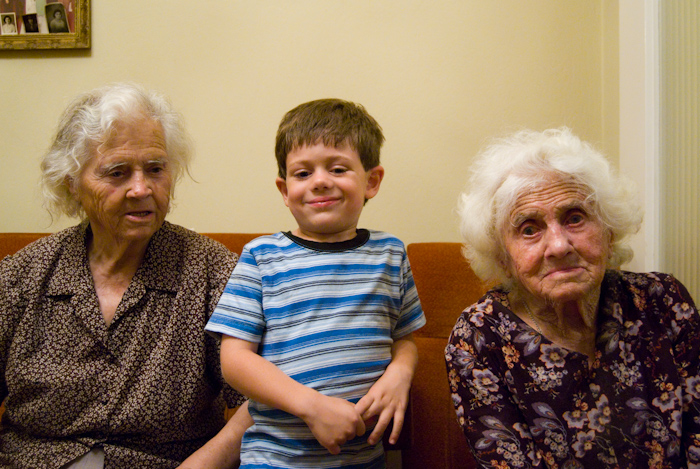
My mother's two sisters, Thea Thespina (left) and Thea Maria (right) on either side of Theophanis when we visited Greece a couple years ago.
My mother’s sister, Thea Maria, died the other day. She was 101 years old and was the oldest of six children, Maria, Thespina, Eleni, Sophia, Efrosini, and George. Yes, five girls and finally a boy.
As their mother died very young, when my mother was only three years old or so, Maria took on helping to raise the other children. My mom told me stories about how hard she worked and how she was often strict with them. She also told me about how, while still a girl, Maria broke her ankle badly. In the hills of the Peloponese back in the 1920’s, there was not great medical care. The villagers set it as best they could and let it heal. But she was considered crippled after that. How crippled? I’m not really sure. What I do know is that she didn’t work in the fields after that, and she didn’t attract a mate. When she died this week, she had been living with her sister Thespina for the better part of 70 years.
They lived together in Thea Thespina’s house in Athens. Uncle George, the baby of the family, had lived around the corner and looked after the sisters. He bought groceries. He fixed things. He drove them to the doctor. He did a lot. He drove them from Athens to the village every summer, and back in the fall. The sisters spent summers in the village of Arbouna, in the family home, the home in which they were all born, until fairly recently. But Uncle George had been too ill to drive everyone around the last few years, and he finally passed away last spring. Neither George nor Thespina had children. As they aged, it fell to their nephew Taki, Thea Eleni’s son, to look after them all. Thea Eleni herself died more than 40 years ago.
Thea Sophia died in 2002. So now it is just Thespina, and my mother, Efrosini. Both have dementia, and my mom is a little worse, I think, though at 91 she is a good five years younger. My mom had a tough year last year, real tough. But she is bouncing back and doing surprising well right now. Who knows, she might have another 10 years in her.
All I know is that I wish I had gone to Greece more, paid closer attention, and knew more about my blood than I do. I suppose there is still time to learn a little more before the last two of the people that connect me to a different world and a different time are gone.
You must be logged in to post a comment.