And then there was one
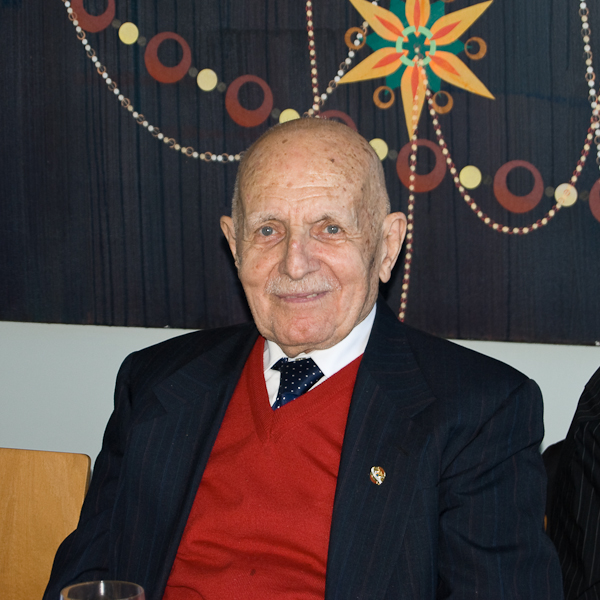
Uncle Pete at his 90th birthday celebration a couple years ago at the Slanted Door.
My Uncle Pete died. They say it was kidney failure, but I’m not sure. I think it might have been exhaustion. So, now my mom is the only one left, the only one of the previous generation of our family left in America.
Peter Panos came to America in the 1950s. He came from Greece without knowing the language. He came crippled, with hip dysplasia that was never treated in his mountain village. He came with his wife and a three-year-old daughter, Aglaia, who had inherited this disease. He came believing he could help his daughter and make a better life for his family. And he did.
Greece had suffered. The village, the families, they all suffered. There was the depression, the Second World War, the Nazi occupation, then the civil war. There was rural life in the mountains of the Peloponnese, a region that had a long history of resistance, of the Ottoman Turks, and then of the Germans. A relative told me that the village of Arbouna prides itself that no Turk ever stepped foot in the village through all the years of occupation. I don’t know if that’s true or not, and it doesn’t really matter. Today the village is decimated, like so many others in Greece, by the great migration out of the countryside, out of the olive orchards and fields, out of the sheep and goat pastures, and into the big cities. And for some, into America. With the wars, Uncle Pete’s opportunity to continue his education and develop his love of classic literature ended. But he was smart as a whip, talked a thousand miles per hour, and was creative with his big strong hands. Eventually, he talked Sophia Vlahos into marrying him and going to America.
Uncle Pete knew how to repair shoes. He found himself in central California. He opened a shoe repair shop in Marysville. It burned in a fire. He bought land. It was a swindle. He opened another shop in Stockton. It didn’t work out. He always moved the family and tried again somewhere else. Uncle Pete met every adversity with renewed determination to overcome and to succeed. Energetic, driven, proud, and smart, he always figured out how to get through tough times and make the next opportunity happen. He also had a deep, fiery faith in the Orthodox Christian Church. He had faith that no matter what is thrown at him, Jesus Christ is with him and will support him. Eventually. he landed in Fresno. By then, there were three children. There was a boy with Down’s syndrome, and the golden child: a boy, strong, blonde, and blue-eyed. In Fresno, things seemed to head in a better direction.
Uncle Pete liked being in the middle of things, a trait he passed on to his son, Tommy. He loved introducing people to one another and easily made many friends. In 1960, he and his wife Sophia brought her sister out from Greece to help out. The 40-year-old spinster had had her own hard life in Greece, working as a housekeeper from the age of seven. The chance to go to America seemed worth taking. She came to work, but far from slaving away in her sister’s home, Efrosini Vlahos was soon married. Uncle Pete had a niece in San Francisco, Olga Rakos. She had a friend in Fresno, Maria Kalsoyas. And Maria knew Paul Serafimidis, 20 years Efrosini’s senior. By 1962, I was born.
To be honest, Uncle Pete was often a difficult person. It’s paradoxical because to anyone outside the family he was always perfectly charming, often deferential, and of course, generous. But with family it was often different. He could be controlling, and short tempered. He always wanted things his way. This always came from a conviction that he knew best, a desire to help, and an expectation of respect. Sometimes he was hard on Sophia and the kids. Too hard. He was also particularly hard on my mother, his sister-in-law. He teased her and they fought often. But they always made up, and the families always remained very, very close. I suspect a lot of what made him tick was growing up crippled in the highest mountain villages of the Peloponnese. In order to survive he was going to have to work ten times as hard and demand respect from people who might otherwise dismiss him. He did both of these things. He drove his children to succeed and supported them all the way. His little girl with his hips would graduate from UC Berkeley and eventually get her PhD, marry and give him grandchildren. His son Tommy would make it in the financial world of San Francisco. Along the way, a lot of support was needed. Uncle Pete provided it. He believed in them and pushed them. He scrimped and saved and managed to provide financial support seemingly beyond the means of a simple shoe repairman.
I remember some other things. Peter Panos was a master at grafting fruit trees. He always had a small orchard in the yard of any house they lived in, and there were always a couple trees growing four or five different fruit on the same tree. I remember how proud he was of buying new American style furniture, or adding a room onto the house on Griffith Way. I remember his cars, the Rambler, Valiant, and something big and brown from the 40’s. These were all symbols of having made it in America. I remember him driving my family to church every Sunday, since my father did not drive. Uncle Pete couldn’t understand that, but he always did this for us. I remember he was the cantor at church and had an extraordinary voice. I remember he liked to get where he was going early; we were always the first ones to arrive at church in the morning, or at the picnic grounds at Hume Lake. If we were driving to the Bay Area to visit Aglaia, you can bet we were on the road before the sun was in the sky.
There is much, much more to say, but I’ll stop for now. I’ll just say that I love you Uncle Pete, and I am going to miss you for a long, long time.
One day in the waiting room
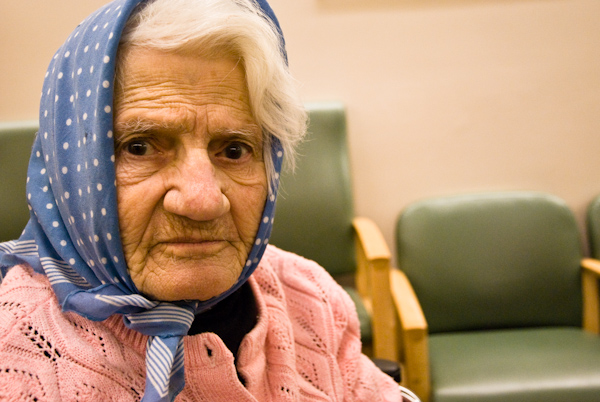
Efrosini Serafimidis
A couple of weeks ago I got a call from the board and care facility where my mom lives. It was late morning. They said she simply woke up complaining of intense pain and couldn’t move her left leg. She had been in bed all morning. I went over as soon as I could. She was clearly not able to move her leg much and certainly could not stand. But as she lay there in bed, she said she would be okay, that she just needed to rest her leg because she had been overdoing it. Then a little later, she said she had fallen down a couple days before and now it was sore. I had seen her a couple days ago. And the day before. This didn’t really quite add up. That’s not really a big surprise considering she has worsening dementia. Nonetheless, I worried that she had indeed fallen and that I wasn’t getting the whole story from the nursing home. They claimed she just woke up with pain in her leg.
She was actually in pretty good spirits and insisted she would be fine with some bed rest. I already had a lot on my mind that day, so I didn’t push it. I decided I would go back home to finish a couple errands and call the Kaiser advice nurse from there. I described the situation as best I could. The advice was to get to the ER as soon as possible. Which we did.
I started to assume the worst, which was that she had fallen and destroyed the hip replacement she had just had done in May, and from which that she had only just fully recovered. In fact, just two days before when I had seen her she was really getting around great with her walker, and taking a few steps here and there without it. This was part of the reason for my increased worry. She has always been incredibly stubborn. I plead with her to be safe and always use her walker. Which she doesn’t.
We spent all day and evening in the ER. They x-rayed her hip. It looked fine. That was a huge relief. She is so small that the x-ray image got about down to her knee, and the ER doctor saw something down there. So eventually they got another set of shots of the left knee. There they saw a bone chip. The location and lack of bruising suggested that she had not fallen. The doctor opined that something like a sudden muscle contraction could have pulled off a bit of her fragile bone. Perhaps she was catching herself from falling. It also appeared that there was not much to be done about it. After finally hearing back from the orthopedic doctors about her x-rays, the ER doc declared that they would put a brace on her leg and that we could leave. But it was now midnight. Everyone would be asleep at her facility. I would have to get her into my car here, and out at the other end—or pay a few hundred bucks for an ambulance. And she was pretty loopy from the morphine, not to mention tired and in pain when she moved. Moving her at the moment didn’t see like a good idea. So, I talked the doc into keeping her there in the ER overnight so that I could come and get her in the morning. Which I did.
We had an appointment with the orthopedists the following week. We sat in the waiting room. I took some pictures. Eventually we saw the doctor. The doctor agreed that surgical intervention was not worth it. But she cautioned that it would be painful for a while. Which it has been.
Hot Water

The Old Water Heater
Hot water has been in short supply around our house for a few years now. The problem is not so much that it runs out, but that it simply doesn’t get very hot. Moreoever, the water heater seemed to go to sleep with the rest of us, and wake up only when we did. This made the first shower of the day a distinctly less-than-hot one. Something needed to be done.
About a year ago, my friend Jason replaced the water heater in his new house with a tankless system. He offered the water heater, which was actually newish, to me. Naturally, I accepted it and resolved to replace my ancient water heater ASAP. There were, however, two problems: the first is that I am only moderately handy and was not confident that replacing the water heater was within my ability to do with a sufficiently high likelihood of success; the second is that my water heater is down in a small utility basement (with the furnace); draining it down there and hauling it out presented additional challenges. And Jason reported that it took more than a few hours to drain the one he’d removed. All these considerations gave me pause. I didn’t want to take such a prolonged time to replace the water heater, leaving both our house and Rocky’s house with no hot water or perhaps any water, and also risk having to call a plumber in on an emergency basis Sunday night if I screw something up.
I procrastinated for months. This wasn’t necessarily a bad thing as I embarked on other projects that seemed less daunting, like painting the kitchen and dining room. That took a couple weeks right there. Or running the speaker cables through the crawl space under the house. Yes, even braving unknown insects and critters in the dark was a satisfactory delay tactic. After several months of this, I started feeling like I really needed to face it. This weekend, the threat of severe marital discord made it a forgone conclusion: this weekend was it.
Of course by this time, the “newish” water heater had been sitting out in the yard, white-trash style, for almost a year. Would it be okay? Would I be calling for an emergency installation of a brand new unit?

Draining the Old One and Pumping It Out
The first thing I had to do was disconnect and drain the old tank. The shut-off valve at the tank did not close completely, so I had shut off the water at the main to the whole house. This led to increased risk should things go sideways, but I proceeded anyway. I finally decided to drain it into a little tub and use a portable sump pump to pump the water up and out to the street. This ended up working very well. The only kink was that (those) in the cheap old garden hose I connected to the pump. (I further resolved that the hose would go into the trash after this job was accomplished.) In fact, the draining of the tank went very quickly, much less than an hour.

Drug the Body Up the Stairs
After this was done, I managed to drag the old tank up the stairs and out to the street by myself without injuring my back or reigniting an old shoulder injury incurred 10 years ago while trying to lower a stove on a dolly down a steep set of stairs. Next, I managed to get the new tank down into the basement and into it’s narrow corner with no problems. I hooked up the water. I hooked up the gas. I turned on the water. Leak…

The Old Water Heater - Connections
I took the stupid cold water connection apart and put it back together again three or four times, trying more teflon tape, less teflon tape, cranking it down more, cranking it down less, etc. Each time it leaked. Finally I got a better light and bent the flex tubing so that I could see in there. I finally realized that the washer had completely deteriorated and bits of it were in the threads. Time to go to the hardware store. I bought a 99-cent washer and, after chiseling out the remains of the old one with an awl, installed it. This time it worked–no leak.
The next test was the real one. Did it heat? Well it took a couple tries to manually light the pilot, but eventually it stayed lit. The burner fired up. Three and half hours and 99 cents later, the new water heater was working! Later that afternoon I scalded my hands at the kitchen sink; I didn’t mind it a bit.

The Replacement Waterheater - All Done!
Cream of Carrot Soup with Dill and a Zing
Susan asked for this recipe on spec. I have to say, I love this soup. And it is getting to be the time of year when I usually make it, so here it. It is originally from “Cooking with Craig Claiborne and Pierre Franey.” I make it about once a year around the holidays for family get togethers, usually either Thanksgiving or Christmas dinner. A small serving makes a soup course that is a fantastic kick-off to a holiday meal. Then again, I’m not sure why it has been restricted to that. I guess I could make it any time. Maybe its the cream and butter. As is usually the case with soups and stews, it will be as good or better the next day. Anyway if you bother to make it, let me know how you like it, or if you have ideas for improvement.
2 lb carrots
4 Tbs butter
1/2 lb onions finely chopped (about 1 3/4 cups)
4 cups chicken broth, or substitute your favorite vegetarian alternative
Salt to taste (think about what’s already in the stock you use)
1 cup heavy cream
1 cup milk
2 Tbs fresh dill finely chopped
1/4 tsp cayenne pepper or to taste
Makes about 12 servings
Trim and peel the carrots, then slice into 1/4″ rounds. There should be approximately 6 cups worth.
Melt the butter in 5 or 6 quart pot and add the onion. Over medium heat, cook the onion, stirring, until it starts to appear translucent, 4-5 minutes. Add the carrots, broth, and salt to taste. Bring it to a boil, then lower heat and simmer for 20 minutes, or until the carrots are soft.
Ladle some of the mixture into a food processor and process to a very smooth puree. Repeat until all the mixture has been processed. If you are planning on serving it immediately or are going to chill it, you can pour it into a large serving bowl as it is processed. Otherwise place it into any bowl until it is all done and you can return it to the pot to quickly reheat when ready to serve it.
Add the cream, milk, dill, and cayenne, and salt if needed. Serve hot or very cold.
Photography Show: Auto Archeology at Chop Salon
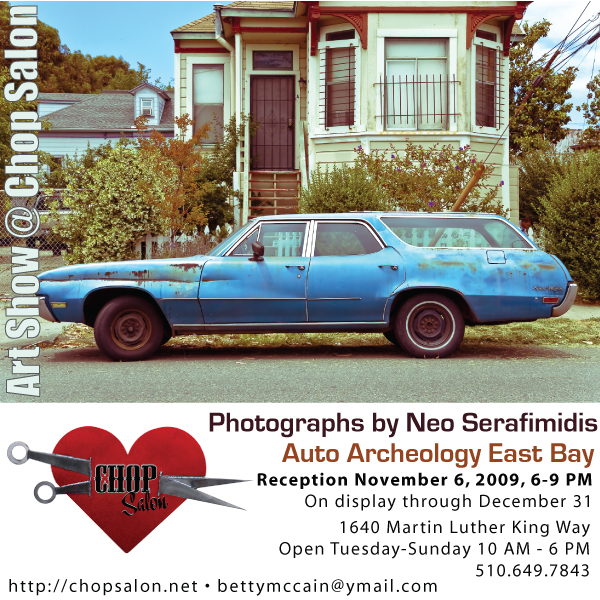
Auto Archeology East Bay
Photography Art Show at Chop Salon: Auto Archeology East Bay
I’m happy to announce my next photography show, coming up very soon! I will have a series of photographs of found autos from around the East Bay on display at Chop Salon hair salon. I have the editing almost done; it’s down to two sets of images, and I’ve got to pick which one to print tomorrow. It’s definitely down to the wire but I expect the show to be all hung and ready for the reception, Friday Evening, November 6. I will be up through the end of December. I will update with start time and more details in the next day or two.
The first set consists of complete broadsides of cars found parked on the street. Set B includes cropped cars. I’m not sure which it will be at the moment, but I’m leaning towards A. I’ll be including the nine square format shots of cropped cars from the last show (yes, sadly none sold from that), and I’m thinking the complete cars will provide the right amount of contrast. Here is the first set.
Here is the second set.
The Old Plymouth
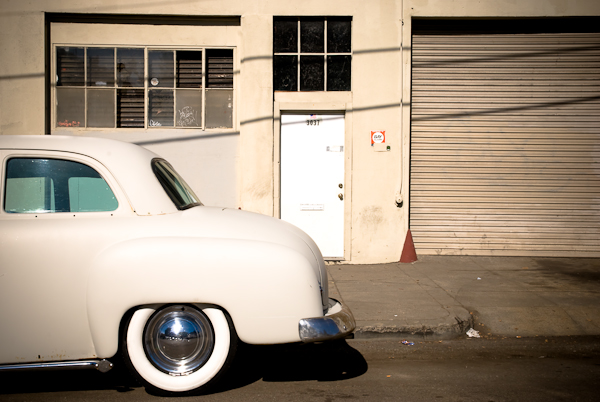
Old Plymouth off Broadway #3
I have a soft spot in my heart for Pontiac. Ever since word of its demise, I have been meaning to take a picture of the sign at the dealership on Auto Row in Oakland. I finally got around to it the other day. And while I was driving around looking for a place to park, I saw some other photo ops on the side streets. This old Plymouth was in beautiful shape. And as I just commented over on flickr, I have to admit I find it very sexy in a zaftig sort of way.
Chimneys of Albany
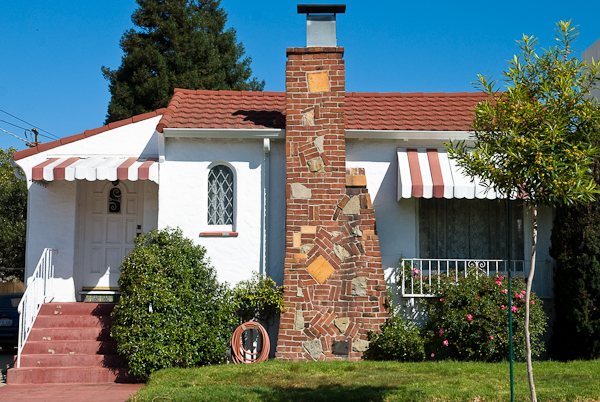
Albany Chimney #8
The leaning, the straight. The clean and symmetrical, the organic mess. Squared, rounded, rock, brick, plastered. These are the fireplace chimneys of Albany.
I would hate to apply a misleading name to something. Looking on the web and within Flickr, “fireplace” seemed like it would be more misleading than “chimney” which is also a little snappier. If there is a better word for referring to the exterior structure of the fireplace and chimney on a residential home, please let me know.
In any case, it seems that these houses, like most of the houses in Albany, were built by a builder named Charles M. MacGregor. Around here, a necessary and sufficient condition for dubbing a house “a MacGregor” is that it has the following floor plan: split level with garage at grade, main living area up about 8 steps, and two bedrooms and a bath above the garage. The master bedroom is right over the garage looking out towards the street, followed by a bathroom , followed by another bedroom overlooking the back. I suspect this can’t be a correct definition, but it works well with the rest of the local MacGregor mythology. Me, I look for whimsical chimneys.
I’ll try to dig more on the man and the myth soon.
Stream of consciousness: Scenic photos
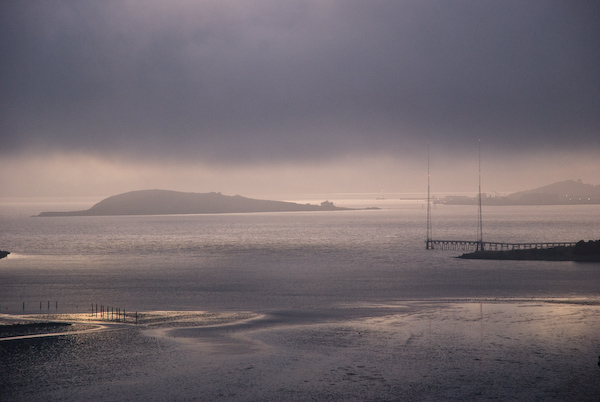
Climbing up on Albany Hill
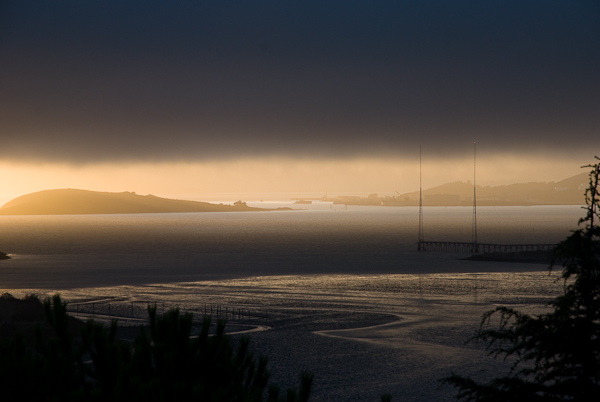
San Francico Bay from Albany Hill, Sept. 19, 2009 #2
I’m not sure what to call the kind of photography I have been primarily engaged in since getting back into it over the last two years. I just know it hasn’t been landscapes and scenic photography. Indeed, I have not been trying to make images that are overtly beautiful or aesthetically pleasing at all.
Yet, there is something irresistible about nature. Often, it is awe-inspiring. And as we all know, sensations of pleasure, well-being, and the loss of self in the one-ness of the creation often lead to addiction. Gotta get that fix again and again. That leads to wanting it for oneself, even in a puny way like making a picture of it.
That’s not to denigrate scenic photography. I find a lot of it pretty wonderful. I just also see the production of it as beyond my ken–not to mention my lacking the wherewithal to afford the gear and the travel to seriously pursue and produce beautiful scenic photography.
All that said, I’ve had fun working with some shots of San Francisco Bay taken mostly as an afterthought–or just because I always have my camera with me, so why not? And the other night I was at a friend’s home that is on Albany Hill and overlooks almost the whole bay. After taking a couple shots from the deck, someone showed me the Richard Misrach book of the Golden Gate. It was inspiring. I came to see the intrinsic interest of a series of photographs of one thing taken over all the different conditions to which it may be subject. I think I may try my own little series from a given vantage point and see what happens. If only I could get a neon martini glass, or rusted car, or dead cow or something in there…
Blogger’s Block and Art Walk Therapy
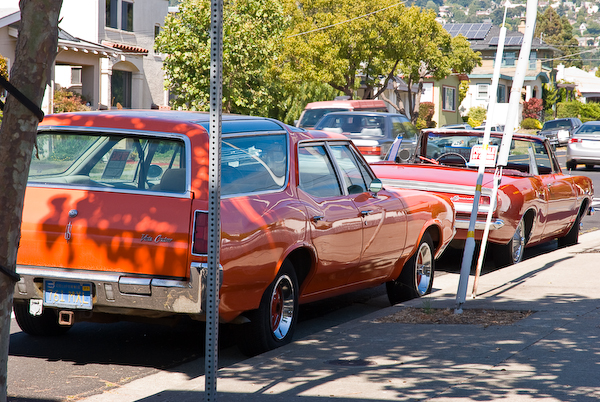
Vista Cruiser and Barracuda For Sale
It began with writing. I found it harder and harder to do. The entries slowed to a trickle and then virtually stopped. It spread to the camera. I was able to shoot, but not with any focus or care. Going through the results at the end of the day, or week, became more and more confusing and difficult. And yet, I feel the need to get the expression out more than ever before. There are many parts to the problem, some of them seemingly contradictory. On one hand, I feel at a loss as to what exactly to try to develop in my photography or how to go about it. I feel like I’ve burned out on square format, color-tweaked, cropped cars. Everything I’ve done seems so dull and amateurish. On the other hand, I have so many ideas floating around that seem like good starting points that I can’t focus on any one for very long. Or even get past the contemplation stage. Underlying all of it is a vague feeling that I should not be thinking about this stuff at all, given my current under employment and other life obligations.
A small breakthrough tonight after returning from a “flickr photographers” show at Vox in Sacramento. Flickr friend Tom Spaulding had some nice work in the show. The show was inspirational, as was art at a couple other galleries, and the whole art party craziness of the Second Saturday Art Walk. It was my first time seeing it, and I was impressed by the sheer size of the turnout and number of galleries, music, clubs, restaurants and other participants. It was definitely worth the hour drive.
Browsing and organizing shots from the past month or so, I came back to this shot of the Vista Cruiser and Barracuda and just really liked it. It vaguely reminds me of Robert Bechtle, whose work I really like and whose name has come up in conversation with artist friends a couple times recently. I tried it in black and white, and really liked that too. It feels like the start of a return of clarity. If I can just keep at it, one shot at a time…
You must be logged in to post a comment.