Blogger’s Block and Video Fun
I am having a mid-life crisis. That is my excuse for not writing anything in such a long time. I also notice that the longer one goes without writing something, anything, the easier it is to continue not writing. So, my new strategy is to participate in that time-honored practice of bloggers the world over: recycling content. So, in the spirit of writing something, anything, in order to make it a habit, i have written this as a preamble to the video below. I think it’s an inspiration to middle-aged breeder hipsters like me. And maybe it is an homage of sorts to Art of Noise.
Once i figure out how to embed this feed here, i’ll do it. In the meantime, here is the link.
Throwing (away) the hand grenade
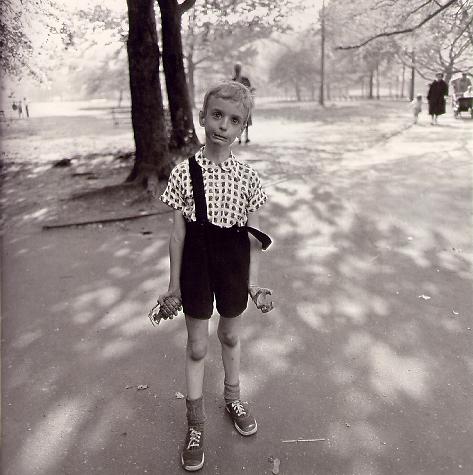
Diane Arbus, Child with a toy hand grenade in Central Park, N.Y.C. 1962
Here is a train of thought that moves from photography to childhood, and the change in outlook that occurs over time.
Joe turned me on to a wonderful post on The Year In Pictures about a Washington Post article on Diane Arbus. In it, some of her subjects were interviewed 40 years after they were photographed as children. Of course, one of the famous images discussed therein is that of the “grenade boy”. The subject, Colin Wood, talks about how, for a time, he was very interested in guns and grenades, and how this led his teachers to believe he was deeply troubled and in need of therapy.
This brought to mind my own childhood obsession with guns and war, World War II in particular. I played with army men, built models of tanks and planes, and played with toy guns for years. My friend Doug and I used to march around with replica WWII firearms and army surplus gear even in seventh grade. Kids where I grew up did not do this in the 70s
I used to make tiny little flags for the army men. I’d get an old sheet and cut tiny little rectangles and color them with crayon or felt tip markers. Mostly it was American, British, and German. They were pretty good, too. Once when I was in 5th or 6th grade, I was playing during recess with a few army men I had brought to school. Among them was a German flag, which had, of course, a swastika. To me this was just historically accurate, as I had German soldiers. But to some teacher it was extremely distressing. I got hauled in and lectured and had to stay after school. The offending item was taken away and destroyed, of course. And I was told, “you can’t just bring that to school and play with it. You just don’t understand what that means, what it stands for.” In fact, I did, and I didn’t. I knew in a matter-of-fact way exactly what it stood for, since I constantly read all about it and knew perfectly well what the Third Reich did. But I had no real emotional sensitivity to the reality of it all, the suffering, the inhumanity of the deeds; I just had a kind of text book understanding. I had no idea what the emotional meaning was for people a mere 25 years or so after the end of the war.
When I started junior high, I took as an elective class something called military science. We did a lot of military drilling, learned how to read maps, practiced target shooting, and once a week we came to school in uniform. This was the California Cadet Corps. It was a pretty geeky thing to do at the time (1974), because kids were growing their hair, hanging out, smoking cigarettes or pot, and trying to figure out the opposite sex (or whatever sex they were attracted to).
I stuck with it through the seventh and into the eighth grade. During my eighth grade year Fort Miller Junior High became a “renaissance school”. This just meant that they were bringing in a hard-ass dean of boys and dean of girls, cracking down on bad behavior and getting back to the basics. So, at one point the decision was made to entirely close the east fields during breaks and lunch to make it easier to police the smokers, etc.
Naturally, there was a huge outcry. It was going to upset all the social patterns to simply lop off 50% of the open space. So, the students did what students did in those days: they had a sit-in in the east field to protest the closure. I participated as we sat there through lunch and 6th period. It happened to be on a Friday, which was cadet uniform day. The protest led to some dialog with the school about use of the field, no one got in trouble, we got some limited use back.
But in the meantime, the next Monday, something awful happened. Naturally, the cadets in the protest were easy to spot. I got called into Mr. (Lieutenant) Eggers office where I got busted down from master sergeant–and Battalion Supply Sergeant–to corporal. This was for bad behavior while in uniform. I was totally bummed. (This was on top of some other minor trouble that I got into over the summer when our battalion went to summer camp at Camp San Louis Obispo. A friend and I had wandered over and climbed onto a couple old Japanese tankettes mounted as display pieces on the parade grounds.) I had started to see, and now it was painfully clear, that military life was not for me. Any wandering off the narrow line was not tolerated. Any questioning of authority and free thinking could not be tolerated. I was not all that good at keeping myself from questioning things, or from straying away when I was supposed to be marching in lockstep. And I could not see the sense of some of the many, many rules laid down. I could not see why exercising my voice in protest was a source of shame for the Corps. That’s not to say there is not in fact a point to these things. But I, the 14-year-old, did not see it. In any case, it was a turning point for me.
I quit the Cadets the next quarter. I lost interest in all things military. I got more into rock and roll. I started reading Carlos Castaneda, I started… well I’ll leave the rest of that thread for another time. For now, let’s just say I ended up studying philosophy, living in Berkeley, taking up photography, and appreciating the work of Diane Arbus.
When the Cultural Intersects the Personal
I have mostly kept to personal writing in this journal. But there are times when cultural and societal conversations possess a gravitas that pulls all matters into their orbit, including the most isolated personal ones.
Recently, i was again reminded of the conversation going on at a site dealing with a topic of importance to all Americans, How to Avoid the Bummer Life. I trust that the below is all that need be presented to establish the apodictic centrality of this site to your life.
Efrosini Holding Neocles
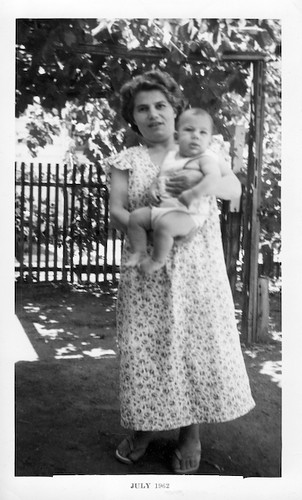
Efrosini Holding Neocles, originally uploaded by neocles.
My earliest memories go back to the house my parents lived in when I was born, at 818 “S” St. in Fresno CA. We were Greeks on the edge of Armenian Town. I don’t quite remember living there, since we moved when I was about two years old. But I almost do. I remember being at the house, although I think it was when my parents were going back and fixing it up to sell when I was about three and half years old.
I remember the look of the old wooden house, the wood floors, the old door knobs, the pulley clothes line that stretched from a window to the far reaches of the back yard. I remember the feel of the hot, powdery dirt in the Fresno summer, and the way it smelled when the water from the bib fell onto it, making dusty explosions that turned to mud. I vividly recall, even now, the smell of the cellar we retreated to for lunch once the sun was high and hot. We sat at a card table and ate in near darkness, the only light streaming in from the cellar door at the top of the stairs. There was a certain musty smell of damp concrete that I encounter every few years, and when I do I am transported back to that cellar more fully than any sci-fi invention could ever achieve.
I toddled around the front yard and wandered into the yard next door. There I encountered the old Armenian woman who lived there. She was very old and bent over, wrinkled and gray. In my memory, she was wandering around her garden tending to her plantings, she wore nothing above the waist and her breasts hung low and flat. She spoke to me in Armenian and I understood nothing of what she said to me. I stood and stared up at her, a little afraid, but not too much, perplexed by the sound of this language. She smiled as she spoke and chuckled around the edges. My mother called and I turned to go, running through the powdery dirt that burned my feet. The smell of Sycamores wafted by as I scrambled up the front steps.
My Brother-Cousin
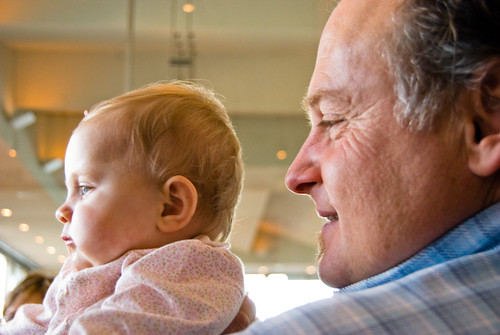
Tommy asked for forgiveness. Tommy Panos and I were first cousins; our mothers were sisters. Our families lived in the same city, Fresno, then on the same block, then right next door with a pass-through in the fence. Our families were close, and I am an only child, and so I always looked up to Tommy as my big brother. He was five years older than me.
I remember when I was about four years old, Tommy’s family would come visit ours on West Cornell Ave., and Tommy would push me around the block on my tricycle — me on the seat and Tommy standing on the step behind me, steering and pushing with the other leg as on a scooter. Typically, the ride started out fun, and then got exciting, then got thrilling, then got terrifying as Tommy jumped off and I frantically tried to steer until my trike slowed to a manageable speed. Then I was ready for another lap.
A few years later we both lived on Griffith Way. I would beg to hang around with him. Tommy would offer to hike me on his bike to go to the 7-11 to get candy or a slurpee. I would get on the handlebars of his Schwinn Varsity 10-speed. Tommy would take off and by half way down the block we would be moving pretty fast. That’s when he’d simply jump off the bike and see how far it would stay up with me on the handlebars before it went crashing over. He’d laugh hysterically, but then come and get me up and hug me, and then buy me some candy.
I would beg, beg, beg for him to take me on his paper route (Fresno Bee) with him. This meant he would hike me on the back of the heavy-duty Schwinn with the paper bags. I don’t know how he survived hiking me along with all those newspapers. Getting to go along meant helping too, and that was fine with me. He would ask for papers and I would pull them out and hand them to him as needed. We would always stop at the 7-11 and get black pepper beef jerky, some candy or a coke.
There was only one catch: Rover. The huge carmel-brown dog at the corner of Swift and College or so. I can’t remember if it was a hound or what. I just remember that Tom would miss that porch and I would be sent to go get the paper and put it on the porch. That meant facing Rover. That deep bark blew my hair back and set me to tears. Usually Rover was lying around right in front of the porch and I would start to inch my way toward the ivy to hunt for the paper, the dog bellowing at me the entire time. Tommy would laugh and laugh. Then, he’d buy me all kinds of treats at the 7-11. We’d sit around and he’d counsel me on bikes and cars and making paper airplanes, anything else that his quick mind conjured. Somehow, I never got bitten. I also never quit looking up to him, appreciating his spirit, sense of fun, and sheer coolness. But I never got over my fear of dogs. It was nice of Tommy to try to break me free of it. Sort of.
We told all these stories before, when Tommy was my best man. We laughed and laughed, and ate and drank, and laughed some more. By then, he had gone off to San Francisco and success selling bond investments. He still had his sense of fun and his need to share everything he found and everything he enjoyed with those around him.
Once when I was about 17, i went to the Bay Area for a concert, and, of course, my friend and I stayed with Tommy. When my friend left the next day, Tommy had insisted I stay the weekend to hang out with him and said he’d get me home. Sunday afternoon came and no arrangements had been made. Tommy called an agent and arranged to fly me back to Fresno. The next flight out of Oakland was in about an hour. We took off from his house in Orinda, drove insanely fast to the airport, and ran to the counter. He slapped the ticket in my hand, and gave me a push. I ran through the terminal and got to the plane with the hostess impatiently holding the door open for me, the last person to get on, for my very first plane flight ever.
There were many other firsts for me and Sarah with Tommy. And Tommy always insisted on paying for everything. Our first time dining at Fourth Street Bar and Grill in Berkeley, back before anything else was there at all; our first time at Zuni Cafe in San Francisco, and at the famous Stars, and innumerable other restaurants, bars and theaters. My first, and only, show at ACT to see Ma Rainey’s Black Bottom. And to the Bammies, and concerts, and to nightclubs here and gone. He took me on my first hike up to Cataract Falls on Mt Tam, and after the hike, straight to Frogs Spa for a soak and a massage. He loved food, and loved to cook, and the list of foods and dishes he introduced me to is endless.
Tommy had keen senses and became a connoisseur of everything in which he took an interest, from primitive art to jazz music. But more than that, he could not really enjoy anything unless he was sharing it with those whom he loved. One of the things he loved to share was people. He introduced so many people to each other, and gathered so many smart, interesting, and wonderful people around him, he was the hub of an incredible 360 degrees without separation. He was the most generous person I have ever known or ever will know. He wanted to do everything for everybody. He wanted to at least do something for each person he ever bumped into.
Somehow, in a way we will never understand, this desire consumed him. His most selfish act was to take himself away from this world and all those who love him so much, in order to escape the feeling that he had to be there for everyone.
Tommy. Honey. Brother. I love you. I miss you. I forgive you. I hope your wondrous spirit will continue to teach me and guide me.
Obit in sfgate.
apricot saga
About the apricot. In 2003 or so, I went down to Dwight Way Nursery and found this Blenheim apricot. It is supposed to be a dwarf or semi-dwarf, I can’t quite remember which.
I knew that there was some challenges to growing stone fruit around here. I know that they like a good cold winter to set fruit well, and, of course we don’t get much of that around here. A couple days of frost here and there is about it. Also, I know some people with peaches who report that periodically large chunks of the tree die for no apparent reason. Probably a blight that likes the relative dampness.
I chose apricot for a couple reasons. First, I thought that the smallness of the fruit might make it more likely that it will ripen. Secondly, my father planted an apricot at the house we moved to when I was five years old. That was a fabulous tree. It had a wonderful shape, an incredible crop almost every year, and the memory of it reminds me of my father. It lived for over 30 years until the renters i had in the house killed it and almost all the other fruit trees in the back yard through a couple fresno summers with no watering whatsoever.
In any case, my apricot produced no fruit the first season, about six or eight fruits the next couple seasons, and about a dozen last season. My friend Rocky had become fond of teasing me about the size of the cobbler he would be limited to in trying to do something with the “annual crop”. And last year, when the tree started the growing season with a perfectly balanced, bowl shape, and good new growth and budding, it suffered the mysterious die-back. One major branch on one side and a couple nearby small branches suddenly quit leafing, shriveled up, and died. The rest of the tree was basically okay, but it was misshapen and unbalanced. I put off my hopes to this year for both fruit and a return to form.
This year, there was not much weather during the spring. No hail, wind, or much rain came along to knock the beautiful blossoms from the tree. As the season progressed there was not a lot of new wood growth–not the several feet that previous years had seen. But it soon became obvious that there was a lot of fruit on the tree.
Around June 1st or so, my Neighbor Hugo said to me as we were admiring the tree, “you might get some 2x4s under a couple of those branches for support. You wouldn’t want them to break.” Well, I didn’t think this was much of a possibility. The aforementioned Fresno apricot never broke a branch no matter how laden with fruit. But after a couple of days, I took it more seriously, seeing that this young tree’s branches were still slender and there was a lot of fruit on them. What had been a narrow upright shape had now settled out into an open bowl of a branch structure. I propped them up with several bamboo sticks I had around.
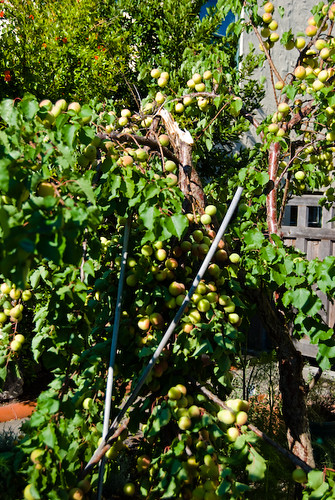
Then about a week later, we had a very windy night. I came out in the morning to find the largest branch of the tree broken, taking down about six feet of height from the tree and several pounds of not yet ripe fruit. I tried to salvage the fruit. Some, I picked and tried to ripen in a paper bag. Much of it I left on the broken branch in the hopes that what was left in the branch would continue to feed the fruit until it could ripen more. Each approach had success rate of about 2% of the fruit involved.
I was pretty disappointed, but there was still an incredible amount of fruit on the tree, so I got over it.
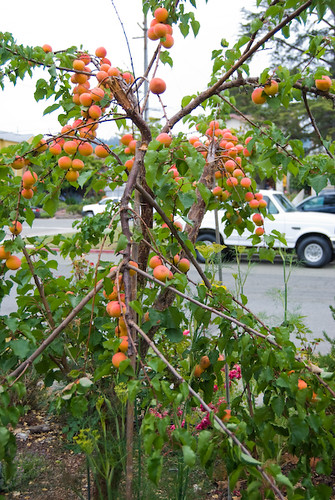
Then the other shoe dropped. About two weeks ago, not one, but two branches on the other side broke, despite being supported. There was a about 10 lbs. or more of fruit that had to be brought in. Fortunately, it was much closer to being ripe. I ripened much of it, and began eating it. As we did what was left on the tree, still a lot, was ripening and being brought in.
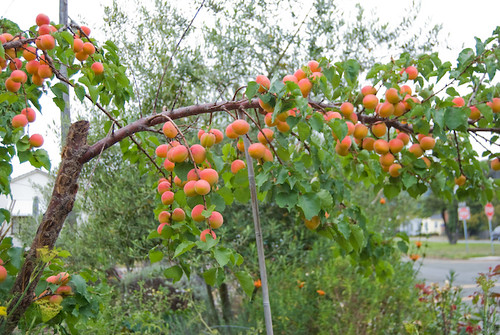
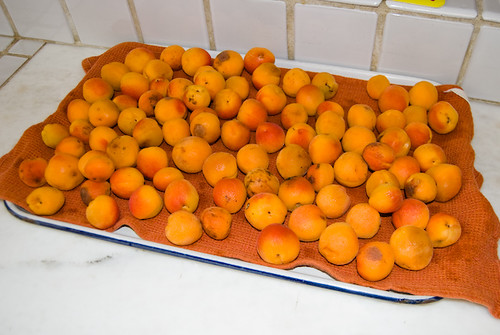
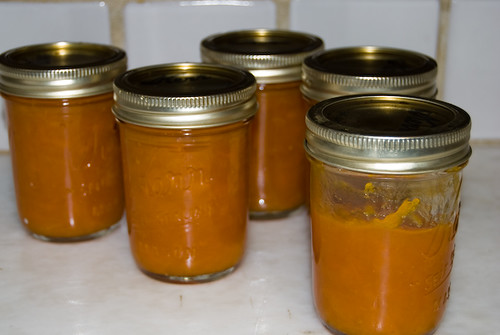
The past week we have been eating apricots like crazy. I gave some to Hugo next door. I gave some to my mom. We brought a bag to Fresno over the holiday. I made about four pints of preserves. I brought some to work. And still, we have a several pounds to pick and finish off the crop.

The lingering question is what the broken limbs mean for winter pruning, next spring growth, and the general shape and health of the tree. Only time will tell.
growing things

I live in Albany in the SF Bay Area. I like to garden, and I especially like to grow edible things. I am originally from Fresno, CA. Fresno is smack in the middle of the most productive agricultural region on the face of the planet. Collectively, these facts usually add up to some cognitive dissonance for me about this time of year.
In Fresno, you can grow practically anything and reap a bountiful harvest. In much of the Bay Area you can grow even more things, but the harvest part is much, much more challenging. This is often referred to as a “Mediterranean” climate, and to me, that brings to mind Greece. Note however, that Mark Twain did NOT say, “The coldest winter I ever spent was a summer in Athens”. The correct reference would be to San Francisco.
So while it is true that the climate in the Bay Area is mild and lots of things will grow, not everything fruits and ripens here. It just does not get hot enough for a sustained period for many fruit trees and vegetables like tomatoes and peppers to really produce a nice harvest. It gets frustrating because things do OK, but not great. Sometimes a plants, like tomatoes, just don’t look happy at all, no amount of feeding, watering, not watering, trimming, etc., cheers them up.
As with real estate so with gardening: location, location, location. I am still experimenting with varieties and locations. And admittedly, some things do just well. Lettuce comes to mind.
In the case of fruit trees, which no self-respecting Greek-American would omit from anything but the tiniest of gardens (for example pots on the apartment veranda), I began my efforts with a Blenheim apricot. But that is enough ranting for now; my experience with the apricot tree will be the subject of the next post.
Paul Serafimidis Studio Shot
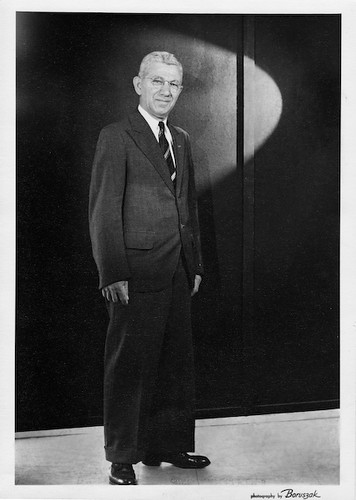
While this last Sunday was father’s day, I did not have much of an opportunity to think about my own father. Now I’m a father, and this weekend both my son Theo and my wife Sarah were sick. My 89-year old mother came over early and required a bit of attention. There was plenty to do around the house and in the garden.
Over the last couple days i saw several really wonderful, touching photos and stories in my flickr contact list. That returned my thoughts to my own father, and i remembered that this morning he appeared in one of my dreams. I don’t know if it was about him; I don’t often really know what my dreams are about.
In my dream, I was walking down the sidewalk with my father and my mother. We were walking down the street where we lived when i was very small, W. Cornell Ave. in Fresno. My father was walking the way he always did when I was a child: very briskly. My mother was walking painfully and slowly, with a walker, just the way she does now. I was sort of going back and forth between them. The strange thing about this was that my mother was out in front, and my father was lagging behind, despite his quick stride. That’s dreams for you. I don’t remember much else right now.
As the time wore on between Sunday and tonight, my vague thoughts about my father intensified and increasingly I wished that I too had thought to commemorate him on father’s day with a photo and a story. Tonight, a lot of these thoughts and feelings coalesced into the realization that tomorrow, June 18th is the 14th anniversary of his death. In 1994, that was a Saturday, the day before father’s day, and Sarah and I were driving to Fresno for a father’s day visit from Seattle, where I had gone off to grad school.
So tonight, I am posting to commemorate him after all. He was a wonderful person and wonderful father. I kinda wish I could channel him so I could be better at those roles myself. Perhaps someday, I will.
The Junked Edsel and the Biodiesel Carnival Bread Truck
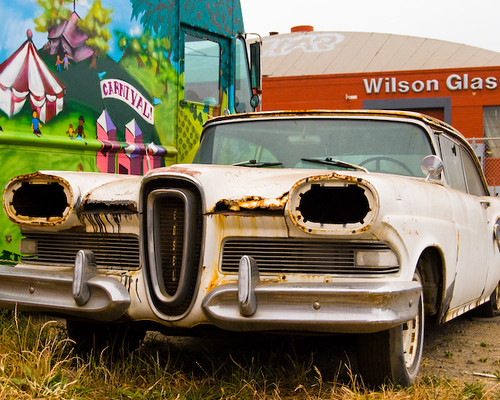
The Junked Edsel and the Biodiesel Carnival Bread Truck, originally uploaded by neocles.
Last Friday, May 30, while biking to work, I stopped to take some quick shots of this junked Edsel parked off Murray St. just west of 9th in Berkeley. I rode through the empty lot, which is essentially an old railroad right-of-way, and set my bike down against the curb. This was far enough back to not have it appear in the shots I was taking. Near the bike was a large white pickup truck parked at the curb.
I had taken just a few shots and had my back to my bike taking the shot above. That is when I heard a loud snapping and crunching sound. I turned around to see the big white pickup running over my bike!
The truck, from Berkeley Unified, pulled over, and the driver got out. He looked pretty surprised himself, saying, “Jesus, that scared the hell out of me.” He apologized and was generally nice about the whole thing, as was I. I was too stunned to be angry or to even take a picture of it, if you can believe that.
The driver said, “That’s the problem with these big diesels, you can’t see right down in front of you.” My bike was a ways out in front of him, so I am not quite sure how he missed seeing it. Maybe he did but misjudged the location as pulled away from the curb.
We exchanged numbers and he drove off, leaving me to assess the damage. Fortunately, he only got part of it, mostly the handle bars. Most of what’s up there was crushed to bits: bell, light, gear shift, brake handle The bars, gooseneck (do they still call them that) and the seat are pretty bent up too. Surprisingly, the rest of it was in good enough shape that I could slowly ride it to work and home again. A professional inspection will tell what shape the frame is in.
Hopefully, I will be able to get the issue settled and bike repaired so I can get back to saving fuel, money, and greenhouse gases. And shooting more commute shots from the safety of the sidewalk.
Mom’s Western Holly
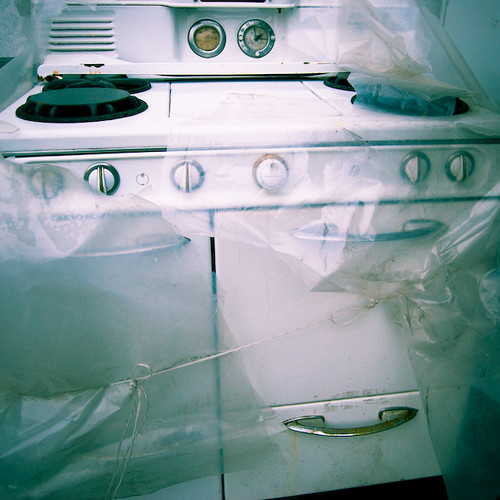
A bit tragic. The stove was in mom’s house in Fresno. The renters swapped it out with the Wedgewood that I had stored in the garage there, and left it out in the elements for a couple months. When I found out, I brought it up to the Bay Area and stored it at my work place for a couple years. I fretted about it and wondered where I could move it. I called some old stove restorers to see about having it serviced and cleaned up. They didn’t want to work on it, but said they would take it off my hands for parts, for free. I said “no”. I eventually had to it move out back of the shop wrapped in plastic for several months. But eventually the wrapping failed, and it got wet and started to rust. The other day, a couple scavengers from the neighborhood came by in an old Datsun pickup and asked if we wanted to get rid of it and a crappy old refrigerator that was sitting with it. At this point, I was no longer able to justify spending a lot of money trying to fix it up, and I had no place to install it, or to store it. I gave it to them. Another little piece of my life lost in the mists of time.
You must be logged in to post a comment.